
This post explores AI job displacement, looking at both the roles that will change the most by 2030 — and which demographics face the most disruption. I break down automation’s impact on roles, sectors, and demographics in the future of work.
Table of Contents
AI job displacement in 2026: What’s changing now?
AI in the workplace … a phrase we’ve all likely heard time and time again in 2025 — and one that isn’t going to disappear anytime soon in the new year. (Yes, you can use an em dash without the help of ChatGPT. Some of us chose to pursue English degrees — don’t ask why.) Want to hear another phrase you might be sick of? AI job displacement.
Look, it’s no secret that many of us are closing the year out on a less-than-jolly note. US prices continue to rise in an economy saturated with inflation, while global job insecurity is significant. In addition to enduring Christmas music (maybe I am being a bit of a Grinch), this year’s holiday festivities feel extra-laden with an air of mourning, apprehension, and uncertainty.
While many sectors have embraced AI — both as a competitive advantage and due to less strategic fears of being left behind — the benefits have been accompanied by rising fears of job displacement. And for many, these fears are now a reality. But who is most affected by AI job displacement? For this examination, I’m not just looking at fields; we’ll also dive into demographics.
The current state of the workforce
The World Economic Forum Future of Jobs Report 2025 revealed the following facts about our current workforce, including how AI is shaping the future of work.
- We will see a structural job churn of 22% by 2030 — with 14% new jobs created and 8% displaced, resulting in a net 7% increase in employment, or 78 million new jobs.
- This totals 170 million jobs created and 92 million displaced worldwide by 2030 due largely to AI, automation, and structural transformation.
- Technology is the most disruptive force shaping the job market, with AI, robotics, and digital access cited among the top drivers reshaping work and prompting both job creation and loss.
- 39% of existing worker skills will be disrupted or rendered obsolete by 2030 — highlighting the urgency of reskilling.
- 59% of the global workforce will require reskilling or upskilling by 2030 — with 29% able to retrain in existing roles and 19% needing redeployment.
- 85% of employers plan to prioritize upskilling, while 40% expect workforce reductions where automation replaces tasks.
AI job displacement, disruption, and new opportunities
From ChatGPT to Gamma to Numerous AI to Gemini, 2026 and beyond will be filled with everything from new AI tools to advanced AI capabilities to new features. And the numbers can confirm that widespread AI adoption is taking place — even if we don’t all know how to best utilize the tools at our disposal.
A 2025 McKinsey report found that 88% of organizations now report using AI in at least one business function. Meanwhile, over two-thirds of organizations use AI in multiple business functions. In an analysis of the job market over the next five years, Nexford University determined which jobs AI tools are likely to most affect, while McKinsey took a critical look at the future of work.
Both reports, as well as the World Economic Forum findings, play a critical role in shaping an accurate view of AI job displacement. But keep in mind before we dive in — while some jobs are becoming obsolete, others are being created.
Which jobs will AI replace by 2030?

Look, I already told you I have a degree in English. So before we dive into the list of jobs that are most at risk, just know we’re in this together. Here’s the breakdown of positions that are facing the most pressure when it comes to AI job displacement.
The World Economic Forum named the fastest declining roles as clerical and administrative (data entry, accounting clerks, cashiers, bank tellers), driven heavily by automation and AI. Decline tends to occur where tasks are: repetitive, rules-based, clerical, predictable, or data-heavy. Here are some examples:
- Office support roles (administrative assistants, clerks)
- Production/manufacturing line work
- Customer service and call center operations
- Receptionists and front-desk roles
- Accountants/bookkeepers (routine tasks — not high-level audit or tax strategy)
- Data entry and basic data analysis
- Sales roles focused on transactional interactions rather than relationship-building
- Warehouse and logistics labor (especially picker/packer jobs)
- Insurance underwriting and risk assessment
- Retail cashiers and checkout clerks
- Some research analysis roles that rely primarily on pattern recognition
- Certain transport and delivery roles with autonomous vehicle expansion
If you work in jobs with tasks susceptible to automation — such as office support, production work, and customer service — it’s a good time to consider upskilling.
Jobs least likely to be replaced by AI

Whether you’re just entering the workforce or considering a transition, the evolution of technology is rapidly redefining the future of work. So which sectors appear wisest to pursue for long-term employment?
High-skill jobs will see a rising demand as we look to 2026 and beyond. The World Economic Forum noted the highest growth roles will occur for tech (AI & ML specialists, big data specialists, software developers), green economy (renewable energy engineers), and care/education roles (nursing, teachers).
Meanwhile, care and frontline roles will expand most in absolute terms — including farmworkers, delivery drivers, construction workers, sales, and food processing jobs. Overall, high-skill and resilient sectors likely to grow, not shrink. Here are some career choices flagged for longevity and growth:
- Healthcare professionals: doctors, nurses, specialists, surgeons, veterinarians
- STEM roles: AI/ML engineers, data scientists, cybersecurity, robotics
- Green economy: renewable energy engineers, environmental scientists
- Skilled trades with physical dexterity: electricians, plumbers, mechanics
- Education and teaching
- Human-centric services: therapists, psychologists, social workers
- Legal professionals requiring reasoning and interpretation: lawyers, judges
- Leadership and team management: CEOs, directors, HR managers
- Arts and creative fields: writers, designers, filmmakers, artists*
- Computer systems analysts and maintenance specialists
- Logistics orchestration and supply chain strategists (not manual labor)
- Research & development requiring novel problem solving
(*I will note that I wasn’t expecting this.)
Overall, growth tends to occur where tasks involve judgment, creativity, empathy, dexterity, or complex decision-making.
AI job market predictions & automation trends
From the available data, it’s clear that a number of patterns are emerging when it comes to AI job displacement in the next 5 years.
- If the job relies on knowledge retrieval, transaction processing, or predictable physical tasks → AI or automation pressure is high.
- Jobs emphasizing human creativity, empathy, negotiation, and complex decision-making remain resilient or even increase in demand.
- By 2030, a significant share of work hours (up to 30%) could be automated, emphasizing the need for upskilling.
- Occupational transitions will be large, with millions of worker transitions across occupations anticipated by 2030.
- Skills and reskilling are central. Raising worker skills and preparing for AI deployment is critical if labor markets are to adapt and benefit from the shift.
- AI adoption remains uneven, with larger organizations and advanced economies scaling faster, while low-income regions risk lagging without investment and skills support.
Who is most at risk of AI job displacement?

When it comes to AI job displacement, we know that certain sectors, fields, and positions are more at risk. But what about the demographics? This is an element that I find is often left out of future of work conversations.
When looking into this, I found a statistic that surprised me: the Economic Policy Institute reported that younger workers experienced more employment issues as opposed to older counterparts up to and during the COVID-19 pandemic. It’s probably far less surprising that, according to the U.S. Bureau of Labor Statistics, jobless rates were highest for people who are American Indian and Alaska Native, followed by those identifying as Black or of two or more races.
When it comes to determining what biases are at play with AI job displacement, not all answers are yet clear. However, it does appear that some demographics are being more affected than others — whether because of newer biases, preexisting ones, or other factors. But let’s take a look at those groups, and how societal sculpting is shaping AI job displacement and determining who is at risk.
Women affected more than men for AI job displacement
Globally, women’s jobs are more exposed to AI-driven automation than men’s. A UN analysis found 4.7% of women’s jobs are at the highest risk of AI disruption vs 2.4% of men’s; in high-income countries that jumps to 9.6% of women’s jobs, which is almost triple that of men’s.
Of course, these numbers raise the question of why men are in more “secure” positions in the first place. Statistics show that women are overrepresented in admin and clerical roles, such as secretarial work, office support, data entry, routine customer service.
They are the exact type of roles that WEF and McKinsey flag as most automatable. At the same time, women remain underrepresented in AI/STEM roles, which are the ones gaining pay and demand as AI spreads. So it’s safe to conclude that AI job displacement is not creating new bias; it’s merely exaggerating preexisting one.
POC workers facing more issues in the future of work
Black workers in the United States are disproportionately affected by AI job displacement. McKinsey took a critical look at generative AI and its impact on Black Communities. Their reporting found that Black workers are overrepresented in 4 of the 5 occupations most exposed to automation.
These include areas such as office support, production, food services, and mechanical installation/repair. Furthermore, they face an unemployment rate that is twice as high as that for white workers, once again demonstrating how AI job displacement is furthering existing employment gaps and biases.
As reported by Business Insider, an earlier McKinsey analysis estimated that up to 4.5 million jobs held by Black workers in the U.S. could be disrupted by automation by 2030. Furthermore, Black workers face about a 10% higher risk of job loss from automation than the overall U.S. workforce.
In other words: If your community is already concentrated in routine, lower-paid roles because of preexisting systems like structural and institutional racism, AI doesn’t just knock on your door; it kicks it in.
Older workers at higher risk for AI job displacement
While the pandemic appeared to hit harder when it came to the younger workforce, it turns out that my suspicions of ageism for older workers is accurate when it comes to AI job displacement. However, there is general uncertainty for both the emerging workforce and older workers. (Is it finally acceptable to be a Millennial?)
An Organisation for Economic Co-operation and Development paper from 2024 examined how different socio-demographic groups experience AI at work. The OECD work points out that older workers are at particular risk of losing out in the AI transition — not necessarily because their jobs are the most automatable, but because they are less likely to access AI-related opportunities and retraining.
Younger workers face a heightened fear of job instability and biased decision-making but may benefit from positive perceptions regarding the impact of technology on society. On the other hand, older workers may benefit from tenure or seniority. However, they tend to have less access to AI-related employment opportunities and productivity-enhancing tools. Furthermore, they face higher biases regarding their ability and willingness to engage in AI upskilling.
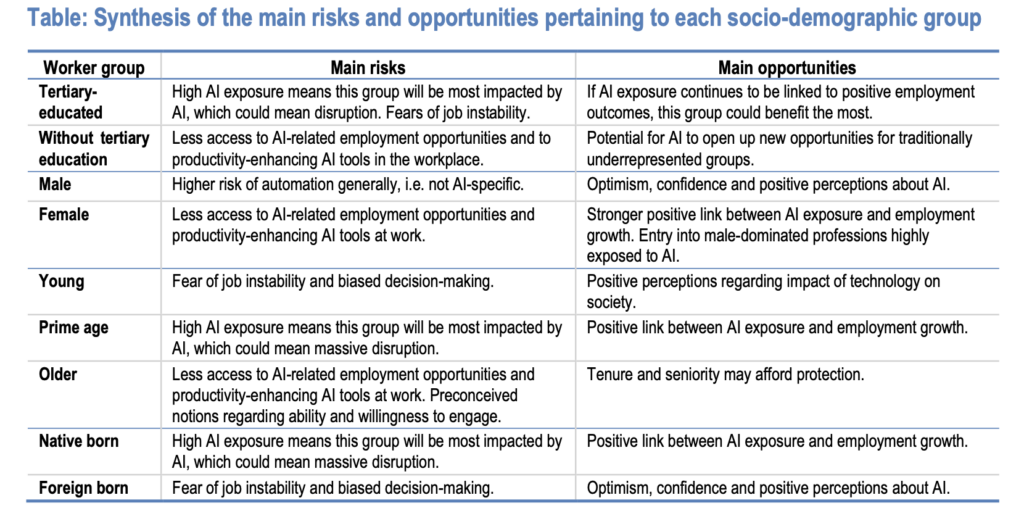
Additionally, WEF also highlights ageing and declining working-age populations as a key macrotrend, with employers worrying about skill gaps and talent shortages while older workers face pressure to adapt quickly to new tools. Future of Jobs Survey respondents cited skill gaps as the biggest barrier to business transformation, with 63% of employers identifying them as a major barrier in the job market over the next five years.
So even when older workers keep their roles, they risk being sidelined if companies invest in AI skills mostly in younger cohorts.
Class demographics influence AI job displacement
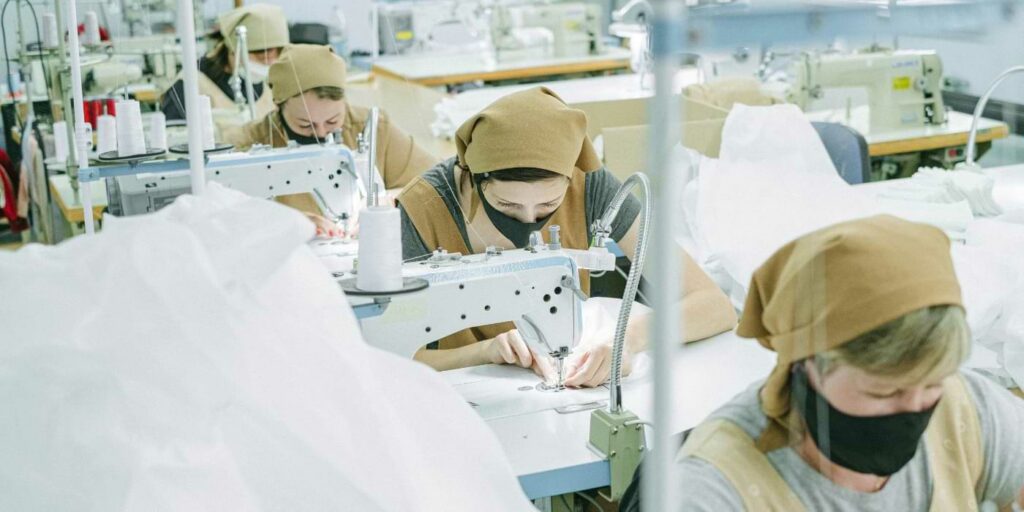
A final area of AI job displacement I’d like to explore is how class and education (which are often tied together) affect the future of work. OECD research finds that workers without tertiary education face a higher risk of losing out — not just because their tasks are easier to automate, but because they have less access to AI-complementary jobs and tools.
Lower-income workers are more likely to be in repetitive service, clerical, warehouse, and basic production roles, such as customer service, retail cashiering, data entry, and warehouse work. These are exactly the types of tasks Nexford, McKinsey, and WEF flag as most automatable.
So lower-income workers get hit from both sides: more exposed tasks, and fewer pathways into the “new” jobs without serious reskilling.
However, they aren’t the only ones affected. Mid-skill white-collar workers — colloquially classified as the not-quite-elite knowledge workers — are also experiencing more job uncertainties. College-educated, mid-salaried white-collar workers also have a large share of tasks that are exposed to AI-driven automation — such as copywriters, junior analysts, paralegals, and some marketing roles.
So it’s not just “blue collar vs white collar”; a lot of mid-tier knowledge workers are sitting squarely in the blast radius. Furthermore, many low- and middle-income countries depend heavily on back-office, call-center, and routine digital work — exactly the jobs generative AI is displacing.
Is AI amplifying workforce bias and inequality?
When we look at the groups most affected by AI job displacement, some might conclude that AI is causing harm. But let’s be real: it’s simply being used as a tool to amplify pre-existing biases on the job market.
The roles AI automates first — clerical, admin, support, basic customer service, routine analysis — are roles many economies already disproportionately have filled by women, people of color, migrants, and lower-income workers.
Meanwhile, the new high-paying AI jobs — ML engineer, data scientist, AI product lead — are mostly going to people who are already overrepresented in tech, such as men, highly educated workers, and those in richer countries.
Will AI widen or narrow the future job market gap?
Many of us have been asking, will the human touch be forgotten? In fact, that was initially my question when looking at AI job disruption and the future of work. But now I think it’s more pertinent to ask — will AI job disruption continue to amplify hiring biases? And, of course, what can we do about this?
The same groups who’ve historically had less power, lower wages, and less access to education are also more likely to be sitting in the jobs AI can automate first — and less likely to occupy the roles AI is creating.
Unfortunately, none of this likely comes as a surprise, as future of work analyses reveal a pattern that is depressingly familiar. To sum up:
- Women’s jobs are almost twice as likely as men’s to sit in the highest AI-risk category, and in high-income countries, that gap grows even wider.
- Black and other POC workers are overrepresented in office support, production, and food service jobs that automation targets.
- Lower-income and less-educated workers are concentrated in repetitive service and warehouse roles that AI and robotics can most easily replace.
- Older workers, meanwhile, may keep their job title but lose out if they aren’t offered real access to retraining or AI-augmented roles.
In other words: AI job displacement isn’t neutral. It mostly runs along the same fault lines of gender, race, class, and age that were already there — and if we’re not careful, it deepens them.
At its core, AI job displacement isn’t just a technological trend — it’s a mirror. It reflects the same inequities that have shaped our workforce for decades: who holds power, who gets access, and who is most easily replaced.
AI isn’t neutral, and it isn’t inherently villainous; it amplifies the structures we’ve already built. If we ignore that, we risk allowing automation to widen divides rather than close them. But if we acknowledge these fault lines now — clearly and honestly — we have a fighting chance to shape AI’s future, rather than simply inherit it.
Continued Reading: The Most Urgent American Rights Currently Being Threatened
Main photo by Jeriden Villegas on Unsplash.