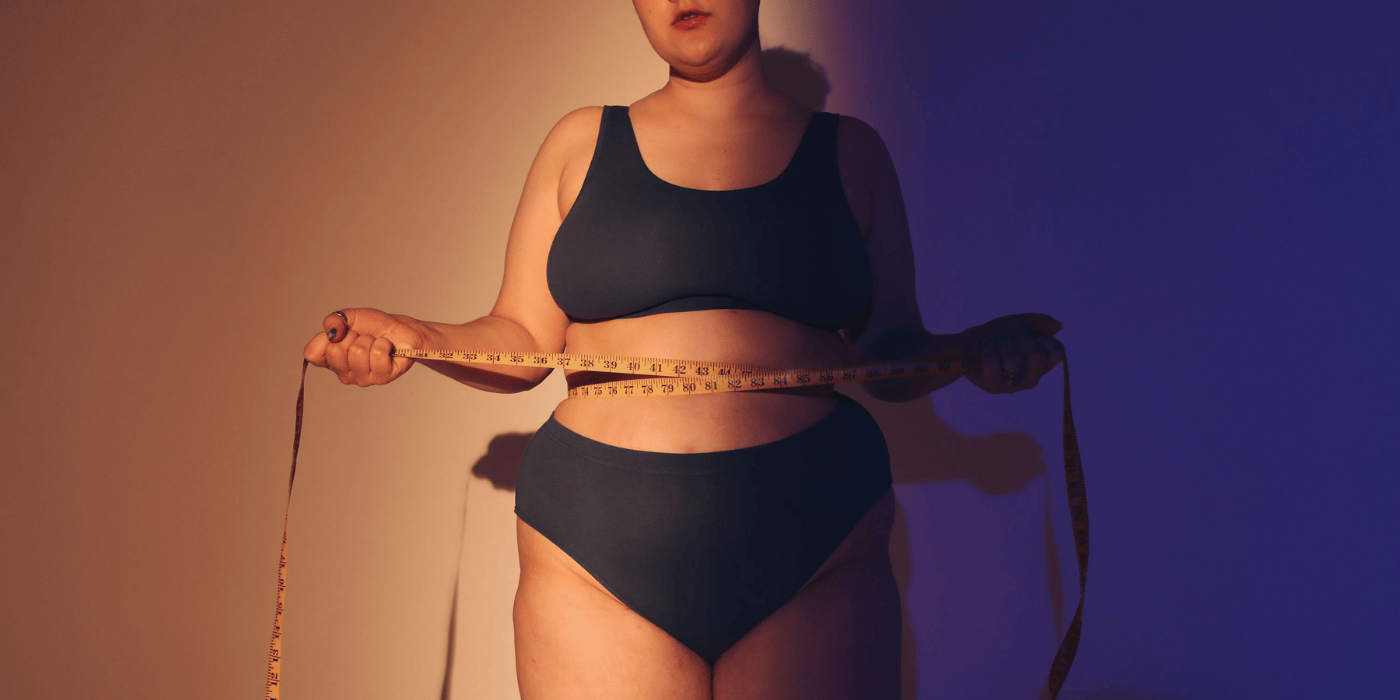
The resurgence of the super-skinny body standard in Western culture calls for the physical reduction of the female body that corresponds with a reduction of the self as women and girls start to occupy less space in both literal and metaphorical ways.
Table of Contents
Bodies are built for functionality, but what happens when that functionality is secondary to what’s in fashion? The idea of altering one’s flesh and bones to meet a trend — which, by definition, changes — seems to devalue the very rights women have fought for in the pursuit of true liberation and equality. Yet this self-trapping paradox hasn’t prevented the reemergence of an unhealthy and unrealistic female body standard that is once again popularizing the concept of super skinny for girls and women.
For a brief period, those of us who made it out of the early 2010s — when fit, healthy, and toned women like Britney Spears, Jessica Simpson, and Jennifer Love Hewitt had their appearances dragged all over tabloid magazines — thought we’d reached a more realistic and balanced body standard. Unfortunately, that’s been overturned.
The days of body checking and thigh gaps were merely lying dormant, with 2026 going down as yet another year that women starved themselves to meet a trending ideal. Perhaps even more disturbingly, the highly publicized reduction of the female body has also corresponded with a reduction of the self as Western women, particularly in the United States, are once again taking up less space in ways that go beyond their bodies.
The Female Body as a Trending Standard
While scrolling through pop culture news in the airport, I was surprised to find a summer vacation post from Jessica Alba. I swiped through the reposted images, stopping short when I hit a thigh-gap beach photo unnervingly similar to the ones that haunted my middle school years. It mirrored the exact images that led me to severely restrict calories starting at age 12, fighting the natural curve of my thighs in pursuit of the most coveted body feature of the era: the thigh gap. (Yes, the fact that I once ranked body parts by desirability is depressing in itself.)
If you’re not familiar with the image, it’s easy enough to describe, since it’s one of the more uninspired ways to publicize a beach getaway. It featured just a nondescript stretch of shoreline, Jessica’s flat stretch of stomach over her bikini bottoms, and her thighs (which naturally didn’t touch). I’d assumed this brand of blatant body-checking was passé in 2026, or at least reserved for people with no other aspect of their life left to boast about.
Despite being a multi-millionaire, the image Jessica shared could have just as easily been posted by countless other women laying on beaches. She wasn’t flexing materialism via her bikini or jewelry, nor was she boasting about an enviable tropical getaway or even her own facial beauty. She was not above what’s called a “body check,” which involves a flagrant flex of one’s thinness.
Such images serve as a reminder that no matter what a woman’s socio-economic status is, her weight remains one of her most valuable, admirable, and coveted assets. Bodies have always been tied to status, wealth, beauty, and the overall perception of value. However, which features elicit which responses have systematically changed over time.
When one walks through a museum and takes in centuries of artwork, rarely will they find a hollowed-out woman held up as the image of radiance and beauty. Women in paintings from centuries past often have noticeably rounder and fuller figures. Depictions of female beauty often focus on ample hips and rosy faces. When did that standard change to become something akin to trying to suck a very thick milkshake through a straw? (A Reddit snark I saw referring to hollowed out celebrity faces attributed to buccal fat removal paired with extreme weight loss.)
The past century has seen its fair share of unrealistic and unrelenting female body standards. While corset popularity died out in the early 20th century, beauty standards have developed with the times to reflect the means and desires of an ever-evolving society. Thinness as a female body ideal is a relatively new phenomenon for women, dating back only to the 19th century, before which fatness was actually seen as the more desirable trait.
In fact, thinness used to be viewed as something related to old age, weakness, and disease, while plump bodies represented vitality, fertility, and a high social status. It wasn’t until religious movements linked weight control to moral virtue and discipline that it began to become the American and European ideal. For a brief period, however, this body standard was replaced with something relatively healthier.
The Move Away From Super Skinny
While the early 2000s media didn’t hesitate to pick apart women’s bodies, the height of celebrated female thinness was the “Heroin Chic” days of the 1990s, when models like Kate Moss were the living embodiment of her infamous quote, “nothing tastes as good as skinny feels.” Eventually, that ultra-thin ideal fell out of vogue, replaced by a new standard.
Arguably no figure has single-handedly had such an explosive impact on shaping Western women’s beauty standards in the 21st century as Kim Kardashian. Kim is credited with shifting modern beauty standards in the early 2010s, popularizing the “Slim Thick” era of roughly 2010–2014 that saw Heroin Chic replaced with a narrow waist sandwiched between a curvaceous, hourglass figure.
While not widely inclusive, the new female body ideal did champion an overall stronger and thicker physique. Tellingly, the Slim Thick era struck at a moment of women’s empowerment that likely wasn’t entirely unrelated, as the look reached its height in the years leading up to the #MeToo movement that went viral in 2017. Women were praised for fuller figures and stronger frames at the same time their voices were finally being heard.
As women began to emerge from the days of protruding bones, sharp collarbones, and visible ribs to instead reveal muscular limbs and flowing curves, their voices also grew stronger. Many finally received the credibility they’d long been denied. They were simultaneously being celebrated for bodies that, while inherently sensual, also weren’t afraid to be strong and take up space. However, this era wasn’t without its caveats.
More on the Bones, But More to Prove
The one recent female body-standard era that allowed women to occupy more space still kept them weighed down by other female beauty ideals that were largely only surgically possible to attain. While comparatively healthier than the Heroin Chic standard, the Slim Thick look was largely unattainable without genetics, procedural assistance, or surgical intervention.
Cosmetic surgery actually dates back as early as 1600 BCE, while its modern popularity started around the 1960s with the 1962 invention of silicone leading to the creation of the silicone breast implant. Public perception around cosmetic surgery improved in the 1980s and ’90s, though it wasn’t until the “Influencer Era” of the 2010s that the stigma started to be seriously challenged as women started openly disclosing their cosmetic work.
Furthermore, the Kardashian body standard did not lead to the lauding of fuller-figured women more broadly; in actuality, only marginally fuller figures were celebrated, so long as they still conformed to traditional proportions. For example, round hips still had to accompany a trim waist. But it wasn’t just bodies that narrowed to a single acceptable template.
While more an effect of a beauty-obsessed society than its cause, the Kardashian beauty-standard shift popularized the “Instagram face,” with Kim’s signature look considered the trend’s template for a beauty so modern it didn’t exist before the app. And while beauty standards have boomeranged back toward extreme thinness in past years, the lust for the “perfect” face hasn’t dissipated. If anything, it’s only worsened.
Plastic surgery and the desire for a flawless external appearance is a gendered phenomenon. Significantly more women get plastic surgery than men, with women comprising 92% of U.S. cosmetic surgical procedures according to a 2018 American Society of Plastic Surgeons report. This figure appears to sit above the global average, where Statista estimates women make up roughly 84–87% of all cosmetic surgical procedures worldwide as of 2024. But now there are other appearance-altering methods becoming rapidly available.
The Return to Super Thin
Eventually the Slim Thick era gave way to a refreshed wave of super skinny female body ideals. As genuine health concerns of the COVID-19 pandemic faded to the background, an era of “Skinny BBL” emerged in post-pandemic society and eventually eclipsed the Slim Thick look.
The very famous body of Kim Kardashian can once again be viewed as the harbinger of a new era of relentless female body standards. She debuted a dramatically slimmed down appearance for the 2022 Met Gala, boasting about dropping 16 pounds in the 3 weeks prior to the costume ball to fit into one of Marilyn Monroe’s historic dresses.
Over the past several years, many other once curvaceous celebs started appearing rail thin in the media, including Jenna Ortega, Demi Moore, and Kelly Osbourne. Sometimes the presence of a celebrity’s implants and glossy spray tans serve as the only factors differentiating them from an otherwise sickly appearance. Many of these celebrity body reveals have been met with a mixture of shock and concern. Though it’s not the cause of weight loss in all cases, many online commenters have questioned the role Ozempic plays.
Originally designed as a GLP-1 receptor agonist used to treat type 2 diabetes, Ozempic was first approved by the U.S. Food and Drug Administration (FDA) in December 2017. Active ingredient semaglutide hit the market with a weight management target under brand name Wegovy in 2021 when it quickly proved a significant aid in rapid weight loss when used off-label. In May 2026, an oral tablet of the drug was approved by the FDA for usage in the United States.
While a prescription for the medication is required, many websites allow GLP-1s to be prescribed online without an in-person consultation or insurance. In 2026, as much as 11% of US adults use GLP-1 drugs for weight loss. Women overall experience more side effects than men. The National Library of Medicine (NLM) declares semaglutide a “gendered phenomenon” with women seemingly disproportionately vulnerable to adverse effects of the drug.
Over 73% of adverse side effects from the drug came from women. The NLM observed that it’s likely women experience more adverse reactions because they experience higher social and cultural pressure to lose weight. Indeed, more women than men use GLP-1 medications in most age groups (men start to use it more after age 65) even though more men are classified as overweight than women and more men have diabetes according to the NLM.
Even once body-positive figures like singer Meghan Trainor confirmed their GLP-1 use and have revealed slimmer frames. Trainor’s 2014 chart-topping anthem “All About That Bass” included lines such as “My mama, she told me, ‘Don’t worry about your size”/“She says, “Boys like a little more booty to hold at night,” as well as a line calling out “skinny bitches.”
As South Park parodied in the May 2024 episode, “The End of Obesity” rich people get Ozempic to become thinner, while those who can’t afford it are prescribed body positivity and told to be happy with their weights. In short: money is the only obstacle standing in the way of possessing the body one really covets.
GLP-1s didn’t redefine beauty standards, though they provided a fast way to attain them. If they’re considered the catalyst for the return to super skinny, it’s because off-label usage provides the means for people to achieve what many have always wanted in the first place.
The Key to Unlocking Perfection
Coinciding with women facing increasingly slimmer beauty standards is the demand that they also appear flawless. Certainly not a new pressure for women in a patriarchal society, the rising popularity of “looksmaxxing” and plastic surgery adds another constraint to women’s lives, though it does also put pressure on men.
Looksmaxxing is not unique to women, as it emerged in online forums and so-called “incel” (involuntary celibate) communities before becoming popularized by controversial influencer Braden Eric Peters, better known as Clavicular, who went so far as to disclose meth use for weight loss and smash his bones in the pursuit of achieving masculine image ideals.
Looksmaxxing has spiraled into a self-improvement movement that broadly reaches women and young girls. Aided by AI evaluation tools, it’s widely accessible to analyze one’s face on apps like TikTok and post in plastic surgery forums asking how to improve one’s look and attain the same disturbingly homogenized ideal that celebrities seem to be rapidly conforming to — aka the aforementioned Instagram face. When even the likes of Emma Stone and Jennifer Lawrence appear on the red carpet with new faces, the pressure on everyday people to alter their looks becomes increasingly unrelenting.
Even the people who changed beauty standards aren’t satisfied with what their money has purchased. Though she was naturally beautiful, Kim has appeared with a dramatically altered appearance on numerous occasions in what some refer to as an ever-changing face. Not yet 30, her younger sister Kylie Jenner has undergone numerous physical transformations since her youth, with her body also seemingly functioning as a response to what’s in style.
Kylie and her friend group appear to go in for major cosmetic work as often as normal folk go in for dental cleanings, debuting a new face or body part like it’s another designer handbag. Though at first Kylie denied having any work done, she’s shared more details in the past years of the procedures she’s admitted to.
Even this is touted as progress, since admitting to cosmetic work at all is more than the public received in the past. While admitting to procedures (albeit in a clearly selective, edited, and deceptive way) in theory helps correct public perception of what’s achievable without cosmetic or surgical intervention, this has only created a new problem for many women. Now people are cataloging exactly which procedures their favorite celebrities have had and saving up to get them done. It’s become such a craze that when Kylie shared which breast implants she’d gotten, it became a trend on TikTok.
Though the Kardashian-Jenner family might be the best example of plastic surgery and the female body ideal in the United States, it’s far from the only one. For example, actress and singer Dove Cameron also underwent a dramatic plastic surgery transformation that led to one online commenter noting their child thought her character had been recast in the sequel to children’s film Descendants because they didn’t recognize her new face.
Female Body Standards vs. Male
While many aspects of the current body-standards discourse are distinctly female, male body standards have also changed over time. However, while the redefined female body ideal encourages women to be wispy, the current male body standard has trended toward bigger, stronger physiques. One only has to watch a film from the early 2000s or before to see how much the male body ideal has changed in the past two decades alone.
The superhero phenomenon of the 2010s saw the image of the ultra-buff male obliterate the previous standard set by celebrities who were attainably fit (if not unattainably attractive) like Clark Gable and Cary Grant of Hollywood’s heyday. Consider that Brad Pitt was the epitome of masculinity in 1999’s Fight Club, though his physique reads as comparatively lean next to Thor’s Chris Hemsworth, or the body Nicholas Galitzine recently unveiled for Masters of the Universe (2026).
Such superhero portrayals clearly represent an extreme male body that hardly anyone could realistically attain or maintain. The slim, shredded appearance captured on film is often the product of a grueling multi-day workout schedule combined with a highly restrictive diet and carefully timed dehydration, a regimen once reserved for professional bodybuilders. (Not to mention the rumored use of performance-enhancing drugs.)
In his role as Steve Rogers in 2011’s Captain America: The First Avenger, Chris Evans used a mix of body double and face-mapping technology to portray a body deliberately scrawny before his superhero transformation. His frail pre-transformation figure was needed to sharply contrast his transformation from weak nobody to a superhero capable of saving the world.
Yet powerful women aren’t given the same studio accommodations when they portray otherworldly figures of power. Audiences weren’t asked to snicker when Ariana Grande, Cynthia Erivo, and Michelle Yeoh all debuted dramatic weight loss for the press tour of Wicked: For Good, their already-slight frames appearing smaller than ever.
The leading women appeared shockingly frail throughout both the press tour and the film itself. Notably, the film racked up over half a billion dollars during its global box office run, while pulling a heavily female audience of around 70-71% of its viewers, with 61% falling into the 18–34 age bracket. Ariana Grande addressed the concern directly, telling fans she was healthier than ever before. While this was meant to discourage worry, it largely served to try and normalize her appearance to her followers.
Suggested Reading: Do Men Hate Women?
Parts vs. the Whole
While men also face unrealistic beauty standards, what is deemed attractive for a man often requires less time, maintenance, invasive intervention, and monetary commitment. Given the dedication to muscle building and maintenance, the ultra buff male body ideal is only realistically attainable by professionals, the upper-class leisurer, or the lower-class laborer. However, men are also permitted to exist as complete individuals.
Male body standards remain largely rooted in the overall body, focusing on factors like height and muscle mass. Aspects beyond looks alone — such as intelligence, personality, character, occupation, net worth, and sense of humor — are also often factored into the overall equation of a man’s societal value. Women, on the other hand, are frequently divided.
In her essay “A Woman’s Beauty: Put Down or Power Source?,” influential American writer and critic Susan Sontag observed that “women are taught to see their bodies in parts, and to evaluate each part separately.” Though the essay was published in 1975, her words still ring true over half a century later as women continue to have their bodies dissected into pieces that are scrutinized in pursuit of better assembly.
While men might feel pressured to work out more or get hair transplants, it’s only the rare and rather startling case that sees them take things to the extreme, such as the highly controversial leg-lengthening surgery German man Leon Otremba underwent to add over half a foot to his height (at the cost of normal walking).
Conversely, the past few years have seen an explosion of new labels to identify perceived flaws in the female body. TikTok trends routinely popularize a new body-negative fixation, such as “violin hips” or “hip dips” labeling the natural inward curves on the side of some hips. Once these perceived flaws become named, they can be targeted in an attempt to eliminate them, even when they are a natural part of a functioning female body.
In more severe cases of body dissatisfaction, people alter their bodies to fit an ideal, sometimes akin to the wicked stepsisters mutilating their feet in the Brothers Grimm version of Cinderella. Fat can be sucked out of inner thighs and redeposited into hips to smooth the “violin” shape. Meanwhile, hairline incisions can be cut to lift the face, implants can be inserted through the armpit, salmon sperm can be injected into the face, and chin bones can be shaved down in the never ending pursuit of the constantly redefined feminine ideal.
The pursuit of perfection has bled across online forums as anonymous commenters pick apart celebrity faces. Some go so far as to measure the distance between facial features in a process disturbingly reminiscent of the anthropometry of Nazi eugenics, which involved a systematic physical measurement of the body and skull with the purpose of classifying individuals into defined racial categories.
In current practice, facial analysis is often done to measure symmetry and provide faces with a score for how far away the person is from achieving a beauty ideal. In many cases, beauty now comes down to a mathematical precision, with “you’re not ugly, just poor” serving as the underlying message and a numerical percentage determining how far away one is from unlocking their alleged physical potential.
Consumer Drive or Something More Sinister?
Turning female body parts into trends could be a response to a consumeristic society in which pushing products is the ultimate goal. Unfortunately, this is the most optimistic way to view this phenomenon. There’s simply significantly less money to be found in self-acceptance.
As Susan Sontag wrote in “The Double Standard of Aging,” men are told they have character when they age, while women are unrealistically expected to maintain a smooth, hair-free, wrinkle-free exterior at all costs. Even this pressure is reaching new extremes.
Consider the sheer magnitude of products that exist to alter a woman’s appearance or promise to shrink her weight — diet supplements, medications, vitamins, cosmetics, injections, procedures. There’s even a scented water bottle that promises to trick the appetite into thinking it’s consuming flavor.
Unfortunately, this feels like an apt metaphor for the position women are being pigeonholed into: we think we’re achieving a new ideal, when in reality we’re just being sold another empty fad. Now the current female body standard is so woefully unrealistic that pre-teen girls have anti-aging skincare routines, teens get “preventative” Botox, and women in their early twenties save up for facelifts.
Snapchat and TikTok filters simulate lip fillers, while influencers brag about going to Korea to get multiple procedures. Color analysis feeds into the looksmaxxing phenomenon with the promise that one only has to tap into their potential and they, too, can be beautiful. And not only is that possible, but now it’s expected when a woman’s worth is intrinsically linked to her outward appearance.
When you consider the hours spent researching procedures, the money saved toward a specific surgeon or injectable, or the mental real estate given over to tracking which celebrity got which body part done, women are being asked to occupy less space in every sense. This includes the space in their own minds that might otherwise go toward something else entirely.
One has to ask who is being served by the pressure to preserve one’s looks, because while someone is certainly profiting, it isn’t us. Are they simply trying to profit from insecurity, is this phenomenon rooted in misogyny, or are we being distracted from what’s really happening to ourselves and our bodies?
More Than Our Bodies Are Shrinking
It appears more than just body mass is being erased. Individuality is being stripped away in the pursuit of conforming to the defined ideal that leaves many surgically enhanced women with uncannily similar faces. But changes seem to go beyond the physical, as women’s personalities, freedoms, and legislative protections are being eroded.
In a 2026 analysis, YouTuber Marina McBain’s video “Women Are Getting SMALLER (And It’s Not Just Their Bodies)” amassed over 1 million views in the first 4 months as she explored how formerly large-personality celebrities like Emma Stone and Jennifer Lawrence emerged with not just new faces and thinner bodies but seemingly new personalities as well. Marina noted how women who were once praised for their vitality and joy now appear notably muted.
This observation coincides with an influx in influencers promoting traditional values. “Trad wife” (short for traditional) has become a viral mainstream social media movement as women promote traditional domestic roles that see them raising families while their husbands work jobs. The Western popularity of promoting a lifestyle built around traditional gender roles started around the time of the pandemic but has since exploded into a widely popularized phenomenon as trad wives seek to convince others they’re living a more fulfilled life.
Trad wife influencers, such as Nara Smith and Hannah Neeleman (Ballerina Farm), also advertise a woman’s role to perform domesticity with poise, grace, and physical beauty. They make everything from scratch and nurture an ever-expanding family while flawlessly decked out in sometimes comically fancy attire. Are these women simply fed up with the demands of modern life and covet a return to simplicity, or are they promoting a lifestyle that has systematically held women down and made them secondary citizens? Perhaps it’s a mixture of both.
Notably, the trad wife lifestyle leans heavily on the husband being the provider. (A potential facade, since the women seem to pull in money from social media.) It also tends to present women as secondary to the men they serve, who appear to be the ultimate decision makers. What’s most concerning isn’t the choice to embrace a traditional role itself, but that the movement asks women to regress to a structure where they inherently held less power without offering much of a modern update. If anything, it adds a new burden on top of the old one: the pressure to perform that regression flawlessly, on camera, for an audience.
Notably, Nara’s husband Lucky Blue Smith is rumored by fans to have first reached out to her when she was underage (denied by the couple, who said he first reached out when she was 18), while Hannah’s husband Daniel Neeleman has been widely speculated about since The Times outlined him as overly dominant, leading to rumors of potential abuse (both Hannah and Daniel have rejected these claims). It’s possible that both women could be victims of the very system they promote, so directing vitriol towards their lifestyle choices seems futile. The more complex and urgent issue is what’s being normalized in society.
What’s particularly worrisome about the return to thinness and over-emphasis on external perfection is how the standards correspond with changing political and global ideas, especially in the United States. It appears the reverse of strong bodies being praised during a time of female empowerment is taking place. Women’s fragility and men’s strength are now both being championed at a time where women are losing historic rights like the constitutional right to have an abortion with 2022’s overturning of 1973’s Roe v. Wade.
Furthermore, U.S. federal policy changes have cut critical funding for reproductive health services, maternal care, and family planning. In some states, debates over birth control access and IVF legality are even being called into question, though laws prohibiting them have not currently been passed. But with the way things are headed, some fear it’s only a matter of time before American women are stripped of even more rights.
Globally, the landscape is quite grim. Women hold only 64% of the legal rights of men, with 54% of countries lacking consent-based legal definitions of rape according to a March 2026 report from UN News. Existing threats of sexual and physical violence remain very much a reality for women and girls in the United States as well.
Data from the U.S. Centers for Disease Control and Prevention (CDC) shows that sexual violence remains a significant problem in the United States, with nearly half of women (and more than 1 in 6 men) experiencing a form of contact sexual violence in their lifetimes. While men are also affected, it remains a gendered threat, with more than 1 in 5 women and 1 in 31 men experiencing completed or attempted rape.
Ultimately, the timing of the reversion to extreme thinness feels like more than a coincidence. A smaller, quieter, more fragile woman is both easier to overlook and to overrule.
Closing Words on the Female Body
Notably, so little of the discourse surrounding women’s self-improvement focuses on factors beyond external appearance, seemingly reaffirming the belief that a woman’s looks are indicative of her worth and value. But even if one were to subscribe to prevailing beauty standards, the lingering question would be, is it ever enough?
Consider the people online commenters love to deem “God’s favorites,” the ones who naturally meet the current Western beauty standard or have purchased it. Even they will always be presented with a new aspect of beauty to covet, whether it be the thigh gap, perfectly rounded hips, or glass skin. Furthermore, the most skilled surgical intervention in the world cannot ultimately outwit time.
Aging, so often considered a curse rather than a blessing, is inevitable. Placing one’s value in a transitory trait is the perfect storm for disappointment, disillusionment, or Death Becomes Her-level disaster. Not to mention, no one knows for how long the current female body and beauty standards will last.
Many of the breast and butt implants of the Slim Thick era are being removed, but they’ll likely be reinserted in a few years’ time. Kylie Jenner is already lamenting that her implants aren’t large enough. One post about a disclosed size has already proved to be enough to ignite a viral social media trend. Who knows the chain effects an update could cause.
Ultimately, every act of so-called reinvention within beauty standards merely reinforces another one. Perhaps the only real defiance is the utter rejection of the prevailing physical female ideals. Women can shave their heads, toss out makeup, forgo botox, or get piercings that spit in the face of current ideals. But there might also be another solution.
Rather than create the conformity of nonconformity, where everyone ends up being different in the same way, individuality and personality might be the path forward. If women are asked to be slim, dainty, delicate, and frail, we can respond by being unapologetically ourselves.
The act of taking up space might not be the sole key to our liberation, but it could at least combat the current regression. At the very least, we should allow ourselves to exist as interior and complete beings. That means no longer viewing our bodies as disconnected parts that need to be solved or judging value by a number on the scale.
Continued Reading: Examining The Gender Safety Gap & Women’s Safety