Finding a woman’s winter jacket without polyester is surprisingly hard. Here’s what you need to know about polyester alternatives available in many European and North American markets so you can make the most informed choices while staying warm.
Table of Contents
For the past few years, I’ve been slowly filtering polyester out of my wardrobe. So far, trying to reduce polyester purchases has been a fairly manageable task. While conscious shopping is often more costly, it does mean fewer impulse buys. I’ve actually saved a bit of money by forgoing some fast-fashion purchases. But now it’s getting rapidly chilly in Germany, and I need a reliable jacket.
The search for polyester alternatives in winter coats has turned out to be my biggest sustainable clothing challenge yet. While I expected most cheaper jackets to be made out of polyester, I experienced a bit of a rude awakening to discover that even jackets for thousands of euros can be 100% polyester. Price, it turns out, tells you very little about quality. (Don’t even get me started on the decline of once reputable fashion brands or the vast quality difference in how materials are produced, such as linen.)
I’ve done the research so that you don’t have to. At the very least, I hope to provide a good starting point for those interested in exploring polyester alternatives. The following guide covers why polyester is worth avoiding, how it sneaks into jackets that look like good buys, the best polyester alternatives at different price points (including vegan options), which blends are a reasonable compromise, and where I’ve actually found polyester-free jackets.
Is polyester really so bad?

We live in an age that is rife with fear-mongering. I’ve seen (unverified) claims that wearing polyester can cause cancer and infertility. I’m not going to delve into things that haven’t been proven. But I can confirm that polyester products have real costs for our planet. When it comes to how polyester affects individuals, it’s often less dramatic. But here are a few good reasons to seek out polyester alternatives when you can.
Polyester is made from fossil fuels.
Polyester is a plastic that comes from crude oils. Most of it is made from petroleum, which means your polyester jacket production starts with oil extraction and an energy-intensive manufacturing process. The chemical process of polymerization turns the petroleum, or recycled plastics, into fabric fibers that can be woven into clothing.
Polyester still remains the world’s most widely produced textile fiber, with the Textile Exchange’s 2026 Materials Market Report noting that polyester production increased in volume in 2025 and accounts for 59% of global fiber production, the same number as in 2024. While recycled polyester production grew slightly in 2025, the report found that systems for recycling polyester remain in early development.
Polyester sheds microplastics every time you wash it.
One of the main reasons to seek a polyester alternative is due to what happens when you wash it. Every wash loosens tiny plastic fibers from synthetic fabrics, creating water pollution. Microplastics, which are less than 5 mm in length, are tiny enough that wastewater treatment plants can’t catch all of them, so a share ends up in rivers and oceans.
Every wash of polyester clothing can have an impact that, when repeated, has created a substantial environmental problem. Each laundry load of polyester clothing can release from 50,000 to over 700,000 plastic microfiber threads, according to the European Parliamentary Research Service. To reduce water pollution, consumers can seek out natural and biodegradable fabrics and reduce synthetic material usage. It’s also helpful to limit the frequency of washes.
Polyester doesn’t biodegrade.
A wool sweater will eventually break down. A polyester one will fragment into smaller and smaller pieces of plastic, but it won’t return to the soil in any meaningful timeframe. Polyester takes between 20 and 200 years to biodegrade, with up to 400 years needed in some landfill conditions. Since most clothing isn’t recycled, this is where most of it unfortunately ends up. Furthermore, the decomposing clothing releases microplastic contaminants into the Earth.
Polyester often doesn’t hold up as well.
As mentioned, polyester is the most commonly produced textile. Although it allows for clothing to be priced cheaper, the savings might not be as impressive over time. Cheap polyester pills, loses its shape and starts looking tired fast. That’s not true of every synthetic, but in mass-market clothing it often means a jacket lasts a season or two instead of a decade.
And personally? Polyester makes me clammy.
This is the least serious reason I seek polyester alternatives, but actually one of the first grievances that had me considering fabrics in the first place once I had enough disposable income to invest in clothing. Polyester is plastic, not poison. If you don’t have highly sensitive skin, you can likely wear it without issues.
Compositionally speaking, polyester doesn’t breathe like natural fibers do. It traps heat and moisture against your body. You want your skin to breathe. And if you’re like me and have sensitive skin, polyester can be more irritating.
Beware of Sneaky Polyester: Lined, Stuffed & Blended
Polyester is a sneaky material. Or, at least, the marketing for women’s clothing can be quite deceptive. Initially, I thought that filtering by material would adequately present me with polyester alternatives. While I’m grateful when online shops offer this option, it sadly proved to rarely be sufficient.
This sneaky material weasels into even the “100% wool” filter when it shows up in lining and padding. Furthermore, plenty of coats advertised as “wool-blend” might contain more plastic than wool in said blend.
Overall, polyester shows up in four main ways, and you have to check the full composition (shell, lining and filling) on every listing.
| How it shows up | What it means | How bad is it? |
| 100% polyester | The whole jacket, inside and out, is plastic. | The one to avoid. |
| Polyester-stuffed | The outer fabric might be cotton or wool, but the insulation (the “puffy” part) is polyester fiberfill. | Bad. The filling is most of the jacket’s volume. |
| Polyester-lined | A different fabric for the exterior, with a thin polyester lining on the inside. | Frustrating. Less plastic overall, but it’s the layer touching you. |
| Polyester blend | Polyester woven together with another fiber, like 80% wool, 20% polyester. | Depends on the ratio. A low blend can be a reasonable compromise. |
If you’re an online shopper like me, unfortunately sometimes you might receive an unpleasant surprise when searching for polyester alternatives, even when you do your homework.
Recently I decided to purchase a Sézane transitional jacket at a higher price point because it was 100% eco-friendly cotton. Unfortunately, when I received the jacket, I discovered that the lining was polyester. However, the listing did not make this clear.
Is a polyester lining just as bad as a fully polyester jacket?
Environmentally, polyester lining is less of a threat. However, this doesn’t mean you have to settle for it as a consumer. Personally, I am frustrated if I am paying high amounts to still have my jacket finished with polyester, especially because this creates the clammy environment I wish to avoid. The lining is where breathability matters most, so it’s very annoying when polyester is used.
Polyester alternatives for jacket linings include cupro, viscose, cotton or silk. (More on those below.) Likewise, sometimes the best you can find is a mostly-natural jacket with a bit of polyester mixed in. (I’ll get into acceptable ratios in the blends section.) As a quick rule of thumb, the higher the natural fiber percentage, the better it’ll breathe and the longer it’ll look good.
The Best Polyester Alternatives for Winter Jackets
In an ideal world, my winter jacket would be a merino and cashmere blend with a silk lining. In the real world, that costs a small fortune. So, here’s the full range of polyester alternatives, from dream options to more realistic ones for a winter jacket fabric. I’ve also provided a quick note on where each comes from, because “natural” means different things to different people.
If you want to explore fibers more in-depth to find polyester alternatives, the 2026 Textile Exchange report includes information on polyester, cotton, man-made cellulosic fibers, polyamide (nylon), wool, mohair, alpaca, leather, down, and rubber, as well as other fibers.
The Premium Natural Fibers
The following polyester alternatives are considered top-grade and luxurious choices for a winter jacket, though they will not suit all consumers.
- Merino wool: From merino sheep. Warm, breathable, naturally odor-resistant and it keeps insulating even when damp. Sheep are shorn, not killed. However, some merino farms, mainly in Australia, still practice mulesing (cutting strips of skin from around a sheep’s tail to prevent flystrike). Look for “mulesing-free” or RWS (Responsible Wool Standard) certified wool.
- Cashmere: From the soft undercoat of cashmere goats, combed or sheared in spring. Incredibly warm for its weight, but delicate and pricey. Cashmere production does not kill the animal, although PETA ties the cashmere industry heavily to the slaughter of goats. Please note that cashmere requires delicate washing. (No dryers!)
- Alpaca: From alpacas, sheared about once a year. Warmer than sheep’s wool, lighter, and often less itchy. Again, creating this polyester alternative should not hurt the animal, as shearing is done annually for animal health.
- Silk: From silkworm cocoons. For many, silk is a dream lining. It’s smooth, breathable and temperature-regulating. However, conventional silk production kills the silkworms; “peace silk” (ahimsa silk) lets the moth emerge first. Silk is also a labor-intensive process that requires many workers and raises worker exploitation concerns.
- Down: Duck or goose feathers, the classic puffer filling and still one of the warmest materials for its weight. Look for RDS (Responsible Down Standard) certification that means no live-plucking or force-feeding. To carry the RDS logo, down must be 100% certified. However, it’s a byproduct of the meat industry, so it’s not vegetarian-friendly. RDS certification means that the feathers are removed from the animals after they’re slaughtered for meat.
- Shearling: Sheepskin with the wool still attached. Known to be extremely warm and long-lasting, but unlike wool, it does require killing the animal. It’s also one of the most expensive options listed.
A quick note on animal fibers: Fabric options like shearling, leather and down come from slaughtered animals. Merino, cashmere and alpaca don’t require the animal’s death, which is why some vegetarians are comfortable with them, though others still aren’t for welfare reasons. If you’d rather leave animals out entirely, there are vegan polyester alternatives.
Vegan Polyester Alternatives
This is the hardest category to shop, because the truth is that many products marketed as vegan are simply polyester packaged with a nicer name. “Vegan leather” is often polyurethane (also plastic) and “vegan down” is usually polyester fiberfill. Even Stella McCartney, the poster child for luxury vegan fashion, lists one of its Alter Mat puffers as 100% polyester shell and lining, with cupro padding, for around $1,950. At nearly 2K, this is genuinely infuriating.
If you’re seeking plant-based polyester alternatives, here are some real options:
- Organic cotton: Great for shells, quilted jackets and canvas chore coats. However, it’s not insulating on its own when wet, so it’s best for mild winters or layering. (While my family in Texas can likely survive off of cotton coats, it’s not going to cut it for me in chilly Germany.)
- Kapok: A fluffy, hollow fiber from the seed pods of the ceiba tree. It’s one of the most promising natural down alternatives. A catch is that most kapok jackets blend it with polyester. For example, some of MUJI’s quilted jackets use a cotton-kapok front, but the reverse side is polyester.
- Hemp and linen: Durable, breathable shell fabrics that get softer with wear. More common in spring jackets, but good for layering pieces. (However, as I warned earlier, not all linen production is equal.) Once again, linen is not going to cut it in frigid winters.
- Cupro, Tencel/lyocell and viscose: Plant-based (wood or cotton-linter) fibers that make great polyester-free linings. For many vegans seeking polyester alternatives on a budget, this might be where they start to compromise.
Finding the Right Accessories
Scarves, hats and gloves are the easiest place to start, because the polyester-free versions are smaller and cheaper. The best materials:
- Cashmere: The warmest and softest, from cashmere goats.
- Merino wool: Warm, breathable and machine-washable on a wool cycle (sometimes).
- Alpaca: Cozy, lightweight and less itchy than many wools.
My tip: flag the pieces you love and wait for sales. Think of each one as something you’ll use for a decade, not a season, and care for it accordingly: hand-wash cold, dry flat, store with cedar to keep moths away.
The Wider Scope: Passable Materials & Acceptable Blends
The focus of my recent search is to find polyester alternatives for winter jackets, but if you’re curious about fabrics in general, there are some other types to familiarize yourself with. When you do have to make a tradeoff (whether for ethics or budget), here are some more polyester alternatives for fabrics.
- Viscose (rayon): Made from wood pulp that’s chemically processed into fiber. It’s plant-based and biodegradable, but conventional production uses harsh chemicals and has been linked to deforestation. Look for FSC-certified viscose.
- Lyocell (Tencel): A cleaner cousin of viscose, made in a closed-loop process that recycles most of its solvent. Soft, breathable, a great lining.
- Cupro: Made from cotton linter, the tiny fibers left on cotton seeds. Silky, breathable, and a common lining in higher-end coats.
- Conventional cotton: Breathable and biodegradable, though thirsty to grow. Fine for shells and linings; less great as insulation in wet climates.
- Nylon and acrylic: Worth naming because they’re often swapped in for polyester. They’re also plastics, so they don’t solve the problem. Acrylic in particular is a common filler in “wool-blend” knits.
What blend ratio is acceptable?
I’m almost ready to share my top polyester alternatives, but a final note is about blends. For some, having 100% natural material might be the bottom line. But others might be more flexible about seeking alternatives. This is just my opinion, but here’s a realistic breakdown:
- 90–100% natural: The goal.
- 80/20 (natural/polyester): A reasonable compromise, especially if it’s a coat you’ll wear for years. The polyester often adds structure or durability without causing as much environmental harm or potential skin irritation.
- 60/40 or 50/50: Proceed with caution. You’ll start losing breathability, and these often pill. And be warned: many “wool-blends” might be minority wool.
- Under 50% natural: This is a polyester jacket with good marketing.
One caveat: a “70% wool” coat with a polyester lining and polyester padding may contain more plastic overall than the label suggests. Always check every component, not just the headline number.
Where can I find polyester alternatives for women’s winter jackets?
It’s finally time to explore which brands offer polyester alternatives! This section was by far the most difficult section to create. The issue is that, at least in 2026, it’s genuinely hard to find a polyester-free coat on a budget. Companies I might have relied on a few years ago, like Reformation, now have depressingly downgraded their materials for many items while continuing to inflate prices.
I will add that many polyester-free winter jackets are likely bulkier and heavier than polyester options. I currently have a polyester jacket that I can roll up into a tiny bag, which is undeniably convenient for layering while traveling. I should also add that higher-end jacket purchases are dry clean only, though one likely only washes a winter jacket annually.
Here are some e-retailers and brands that I’ve managed to locate polyester-free or polyester-light composition mixes for winter 2026. I’ve also included some that I’ve seen come up in conversation, as well as whether or not they’re worth it.
Stock and compositions change every season, so check each listing before you buy. But hopefully if these brands still have integrity in 2026, future seasons can be promising. I also tried to check out known websites in multiple countries to provide varied options for women across Europe and North America. (No links are affiliated, and there is no commission from any. Just genuine observations.)
H&M Group: Some Surprisingly Good Finds
My personal search for polyester alternatives finally found some success when I came across the COS website. COS is owned by one of the biggest fast-fashion retailers, the H&M Group. COS, Arket, and & Other Stories are marketed as higher-end alternatives to H&M clothing.
COS offers wool and alpaca coats, some fully polyester-free, others blends. Each jacket differs. For example, this wool-mix jacket is 68% polyester and only 32% wool with polyurethane stitching. As a better choice, this option is 76% wool and 24% polyamide with 100% viscose filling, although it is double the price.
There are a few options on the German website that contain 100% natural materials. It probably doesn’t surprise you, but most of the genuine eco-friendly options are a lot more money.
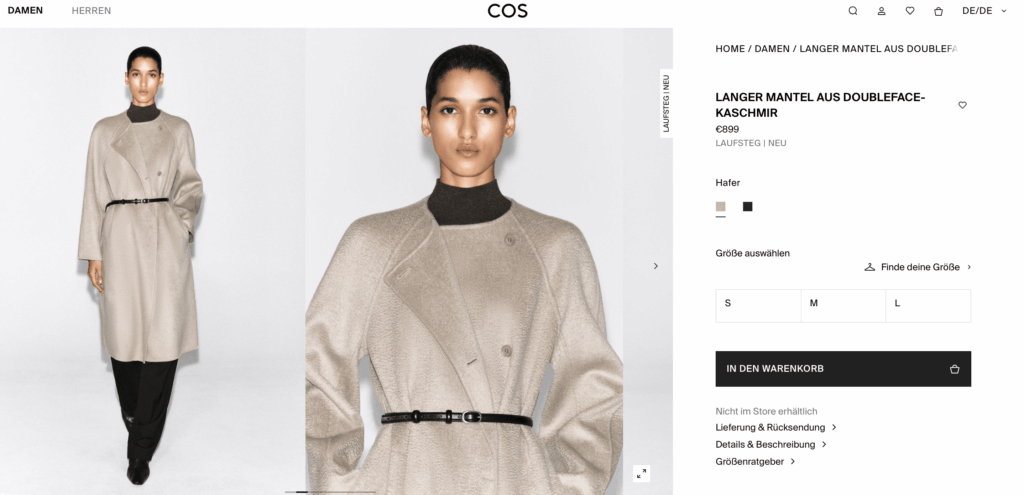
- 100% cashmere long coat (€899) (Note: This 100% cashmere jacket is priced the same, but contains 100% lyocell filling.)
- 100% cashmere short jacket with belt (€799)
- Oversized jacket listed as 100% wool outer material (€199); however, the inner material is not listed, so I am uncertain if it is truly 100% wool. (Though a great price.)
Personally, I’m trying my luck with this jacket, which is 73% wool, 22% polyester, and 5% alpaca. It has yet to arrive, and I don’t know if it will be warm enough for a complete winter jacket, but I’m hoping I can layer it with wool sweaters. With a 10-percent welcome coupon, I purchased it for €135, which I find to be reasonable for the composition.
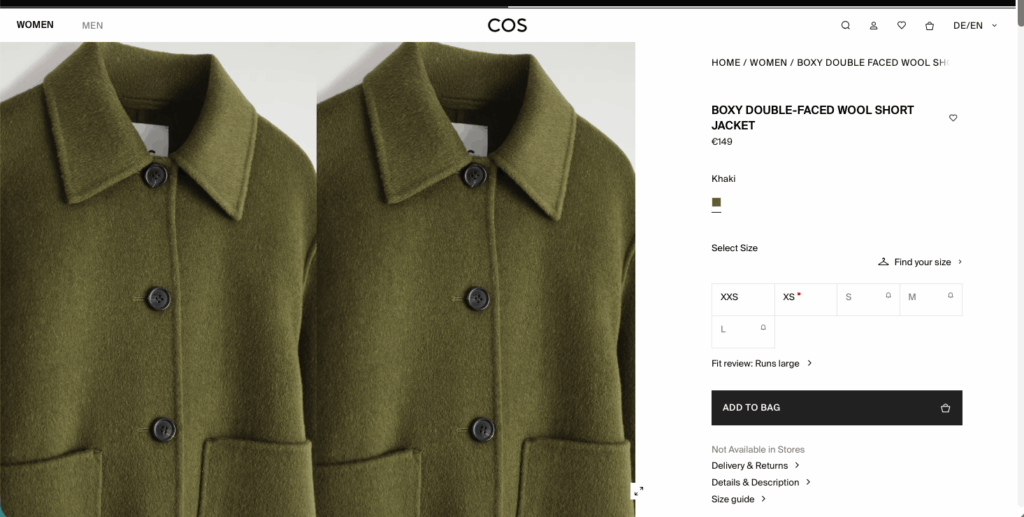
If you’re open to blends, I found a few listings that I would personally consider depending on my budget.
- Long coat with 72% wool, 23% polyamide, 5% cashmere (100% viscose filling), (€299)
- Wool-twill jacket that is 78% wool, 21% polyamide, 1% other (100% viscose filling), (€299)
I also checked out the other higher-end H&M Group brands, Arket and & Other Stories. Off the bat, I discovered that Arket has an RWS-certified 100% wool coat on their UK website (£299) that is somehow confusingly listed as a wool-blend. (Is it 100% wool? Or 100% blended wool?)
Arket also offers a relaxed shearling coat that is 100% lamb leather with 100% cotton pocket lining, though the caveat is that it costs £1,090. But I will add that a good coat is an investment. There are also options like this coat that is 80% wool and 20% polyester (£229). Again, the listing confirms it is RWS grade.
Unfortunately, I didn’t find so many high-quality polyester alternatives on the & Other Stories website, so I’d stick to COS and Arket for winter jackets.
Next: A Range of Quality Brands
After frustrating myself to no end trying to find a genuinely plastic-free coat on Zalando and About You, I was pleasantly surprised to discover that Next offers some actual 100% wool brands. (Though don’t be fooled: filtering for 100% wool still delivers a number of mixes.) Some pricier finds include:
- AllSaints Black Ellis coat, 100% wool (€658)
- Barbour Green Bedale Wool Coat, 100% wool (€658)
- Hobbs Black Sara Wool Coat, 100% wool (€625)
- Whistles Nude Morgan Funnel Neck Coat, 100% wool (€542)
I also found something that I had thought impossible to locate: a 100% wool puffer jacket! It is the Reiss Brown Tory Petite Wool Hooded Puffer Coat. At €465, it is currently out of my price range, though I’d be keen to try it.
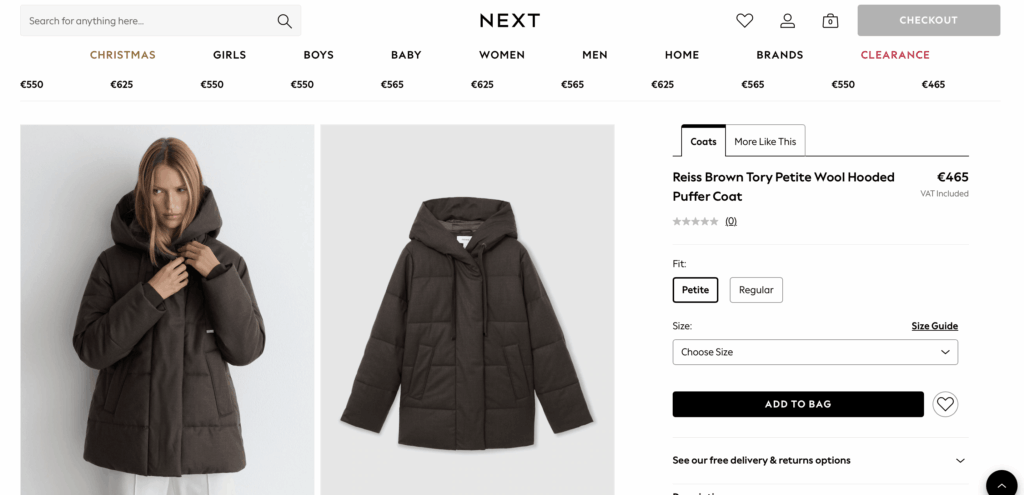
The Hobbs Brown Petite Lumi Puffer Coat (€312) is also 100% wool, though it has 52% polyester & 48% viscose lining. (And two reviewers note that they don’t like the belt.) I also found a more affordable option, but reviews are mixed.
- The Crew Clothing Wool Blend Peacoat, 100% wool (on sale for €136, originally €272)
Overall, Next seemed to provide a fair amount of actually 100% wool options compared to the other multi-brand retailers I checked out, many of which had me sorting through hundreds of listings to finally find a high-integrity option.
Lilysilk: A Pricey but High-Quality Choice
Lilysilk is a website I’d never heard of. It’s a luxury international e-commerce brand, founded in 2010 and best known for silk. What won me over is that you can actually shop by material. The menu breaks everything down into categories like silk, cashmere and wool, and blends like 70% wool and 30% cashmere, so you’re not stuck scrolling through hundreds of mislabeled “wool” listings. (I’d like to formally request that every other retailer adopt this.)
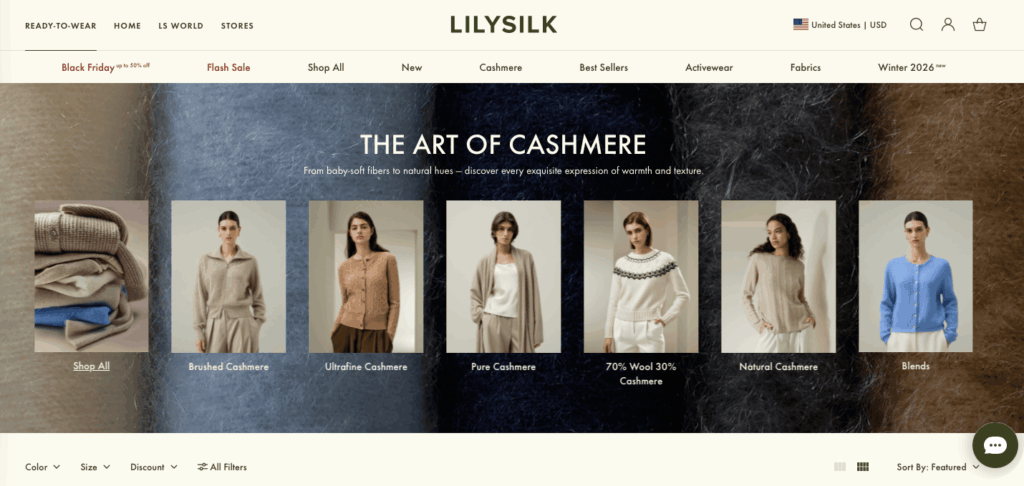
On paper, Lilysilk seems like a fantastic option for polyester alternatives. Numerous coats use RWS-certified wool or cashmere. Most of their coats are made from double-faced fabric. That means two layers of fabric woven together, so the coat often doesn’t need a separate lining at all. For anyone tired of finding a polyester lining hiding inside a wool coat, that’s a big deal. Some options include:
- Oversized Double-Faced Silk-Wool Coat, 90% RWS-certified wool, 10% mulberry silk ($699)
- Double-Faced Wool-Cashmere Short Coat, 95% wool, 5% cashmere (on sale for $384, originally $549)
- Sankt Moritz Coat, 70% wool, 30% mulberry silk fabric, 100% cupro lining ($899)
The catch, of course, is the price. These are investment pieces, and the full prices are steep. Lilysilk appears to run frequent sales, however, including Black Friday discounts, so this is a good place to flag a coat and wait. Those interested in making a purchase but worried about the price can also check out Lilysilk online reviews to verify quality.
Patagonia: Mixed Blends With Quality Guarantee
A name that came up in my search for winter jacket polyester alternatives is Patagonia, a brand that’s established itself as mainstream eco-friendly fashion. However, this doesn’t mean all of its products contain 100% natural materials.
I know not everyone has the funds to invest in a pricey jacket, especially when they don’t know if composition and price equal quality. Patagonia has an Ironclad Guarantee that allows customers to return products for a repair, replacement, or refund if they are not happy. However, many of their winter jackets are blended mixes of materials.
Uniqlo: Skip for Polyester-Free Jackets, Good for Other Items
Uniqlo is also a brand that I saw mentioned a lot, and I know it’s available in many parts of the world. It also offers price ranges that are more affordable. As a bonus, many of their products are unisex.
While I found some really cozy and warm-looking coats, they are unfortunately still largely polyester. Likewise, even the wool-mix coat on the German site (on sale for €183, originally €229) is 55% wool, 40% polyester, and 5% cashmere for the body.
Uniqlo does offer a wide range of cashmere sweaters, like this 100% cashmere pullover (€90) currently available in over two dozen colors and seven sizes. They also have a range of affordable accessories, like these cashmere gloves.
Abercrombie: Skip for Jackets, Other Items Vary
I heard some mixed reviews about Abercrombie, with some complaining that the men’s wool was 100% wool while the women’s wool sweater options contain blends. So I decided to investigate.
They do offer a 100% RWS-certified wool belted coat on their US website ($320) … that unfortunately has a 100% polyester lining. (They were so close!) Other options, like this wool-blend trench coat ($250), are only 55% recycled wool.
When it comes to Abercrombie clothes in general, I like some of their styles and cuts. They also offer petite/normal/long clothing lengths, as well as curvy options for some clothes, which appeals to a wider range of consumers. However, I was extremely disappointed when I realized my Sloane pants were, in fact, polyester. (Though that might explain why they make my legs itch when I sweat.)
Abercrombie does offer 100% cashmere crew sweaters ($199) and 100% cashmere cardigans ($199) that come in various colors. So some of their items are suitable for polyester alternatives for women’s winter clothing.
Smaller Eco-Friendly Suppliers: Individual Countries Vary
Many people likely sought out this list because they are environmentally conscientious. Understandably, they might not want to give their money to the likes of H&M Group. While it came up as the best option for me based on my budget, needs, and style desires, there are also smaller eco-friendly brands to be aware of.
Each country has a different range of eco-friendly suppliers, as many aren’t able to offer worldwide shipping. One great option I found in Germany is Hessnatur, which lists the composition of the clothing and where the materials came from.
They have a wool fleece with organic merino wool from Argentina (on sale for €320, originally €400). I will add that the reviews on this product are mixed, and the jacket also isn’t likely warm enough for genuine winters. However, this does seem like a very promising site for finding eco-friendly clothing in general.
Thrifting: The Secret Weapon

One of the top recommendations I kept coming across for polyester alternatives was to buy secondhand. Older jackets were far more likely to be wool, cashmere or down, and they’ve already proven they can last. A 20-year-old wool coat that still looks good is better quality evidence than any product description.
In the US, thrift stores and vintage shops are quite common. In Germany, it’s trickier. Thrifting isn’t as big a part of the culture, at least not where I live. Berlin has great flea markets and clothing swaps where women sell their own pieces, and that’s perhaps where I’ll end up finding a jacket.
If you don’t have good secondhand shops nearby, online resale is the next best thing. I’ve included a range of options by region to help with the search for reliable polyester alternatives.
Germany & Europe
- Vinted: The biggest secondhand clothing platform in Europe. You can filter by material, though not all people will include this information.
- Kleinanzeigen: Germany’s classifieds site. Great for local pickup and better prices, though you’ll do more digging.
- Vestiaire Collective: Pre-owned luxury and designer pieces, with authentication. Pricier, but a decent bet for cashmere and high-end wool coats.
- Sellpy: Secondhand marketplace operating across several European countries. (Yes, it’s owned by H&M Group, too.)
- Momox Fashion: German online secondhand shop with lots of mid-range brands.
- Humana: Secondhand chain with physical shops in many German cities and elsewhere in Europe.
UK
- Charity shops: Oxfam, British Heart Foundation, Cancer Research UK and other charity shops are all common. The UK takes its charity shops seriously.
- Depop: Popular for vintage and younger brands.
- eBay: Still one of the best places for vintage wool coats.
- Vinted and Vestiaire Collective: Both also operate in the UK.
US & Canada
- Goodwill and the Salvation Army: The classic thrift stores, all across the US.
- Savers/Value Village: A thrift chain in both the US and Canada.
- ThredUp: A huge online thrift store, easy to filter by brand and size.
- Poshmark: Peer-to-peer resale in the US and Canada. Vinted is also available in the US, but not in Canada since 2024.
- The RealReal: Authenticated luxury resale, for when you’re hunting for cashmere.
- Depop and eBay: Good for vintage finds.
- Facebook Marketplace (and Kijiji in Canada): Local listings, often cheaper and with no shipping.
Why is it so hard to find a jacket without polyester?
There is one obvious thing that I want to address, which is why the search for polyester alternatives is so challenging. At one point, a few hours into scrolling, I genuinely wondered if this was a futile quest. Maybe polyester is just how jackets are made now, and I needed to accept it.
Then I looked at what kept coming up as the best workaround: thrifting. The reason secondhand shops are full of wool coats and down jackets is that clothes used to be made that way. Jackets were once made with integrity, built to be worn for years and passed on. Somewhere along the way, that stopped.
The short version of why this happened: polyester is cheap, fast to produce and endlessly adaptable, and fast fashion runs on all three. Lower-quality clothes wear out faster, and clothes that wear out faster get replaced more often. And it’s not applied equally. Women’s clothing seems to get the worst of it.
Suggested Reading: How the Evolving Female Body Standard Diminishes Women
Is polyester ever good?
Before I close out, I will play devil’s advocate for a moment. If polyester is the most produced textile, it must have something going for it, right? To be fair, it does:
- It’s cheap. For a lot of people, a €50 jacket is the jacket they can afford. That matters.
- It’s water-resistant and quick-drying. It wicks moisture, which is why it dominates sportswear and rain gear.
- It’s light and packable. Synthetic insulation stays warm when wet, unlike down.
- It’s easy to care for. Machine wash, no special treatment, no moths.
- It’s vegan by default. For people avoiding animal products, it’s often the easiest option.
And to be honest about the research, natural fibers also shed. The difference is that natural fibers biodegrade, and plastic ones don’t. Polyester does have a place, especially in technical gear for hiking or skiing or for people who financially have far fewer options. My issue is that it’s become the default for everyday clothing, where those benefits rarely justify the costs. Furthermore, the society of constant overconsumption has gotten exhausting.
Closing Words on Polyester Alternatives
I want to fully acknowledge that not everyone can drop €400 on a wool coat. Budgets are real, and for many people, several smaller purchases feel more manageable than one big one. Some people need vegan options, some need machine-washable, and some just need a jacket by Friday.
But over time, buying things that last almost always costs less. A jacket you wear for a decade (barring major life changes) is cheaper per wear than one that falls apart after a season, and some clothes these days don’t even make it through one. Every jacket that lasts is one less in a landfill.
So here’s where I’ve landed: buy secondhand when you can, invest when you can, choose the lowest-polyester option you can find when you can’t, and take care of what you already own. None of us will shop our way out of this alone, but every conscientious choice adds up.
If you’ve found a polyester-free winter jacket you love, please share it in the comments. I’m always open to gathering more polyester alternatives.
Continued Reading: Is Brand Storytelling Dead?
Title image from Pexels by Jonathan Borba.
Quick Q&As for Polyester Alternatives
What are the best polyester alternatives for winter jackets?
Merino wool, cashmere, alpaca and down are the warmest natural options for polyester alternatives, with silk, cupro or cotton linings. For vegan polyester alternatives, look at organic cotton, hemp, and kapok insulation.
Is polyester really so bad for the environment?
It’s made from fossil fuels, sheds microplastics in every wash, and doesn’t biodegrade. It has practical benefits, but for everyday clothing, the environmental costs add up.
Can you have a waterproof winter jacket without polyester?
Yes, though true waterproofing is harder. Polyester alternatives like boiled or felted wool, or waxed cotton, are naturally water-resistant.
Why are so many modern jackets made of polyester?
Because it’s cheap, fast to produce and versatile, which makes it perfect for fast fashion. Clothes that wear out quickly get replaced quickly. But there are polyester alternatives available if you search hard enough.